Stop running your styling business out of Canva, texts, and spreadsheets.
One private studio for your client closets, lookbooks, and bookings. All of it under your brand, so you look like the studio you are.
You are running a luxury service on a stack of screenshots.
It isn’t that you’re disorganized. The tools that handle the business know nothing about clothes, and the tools that know clothes don’t handle the business.
The closet lives in your camera roll.
Twelve clients, four thousand photos, no folders. You know she owns a navy blazer. You can’t find the navy blazer. So you text her and ask her to send it again, for the third time this season.
The lookbook takes four hours and dies on arrival.
You build it in Canva, export a PDF, email it. She opens it once on her phone, can’t tap anything, screenshots two looks, and asks you where to buy them. You retype the links into a text message.
The business runs on trust and screenshots.
Invoice tracker: a screenshot. Expenses: the camera roll. Who’s paid, who hasn’t, what you actually made last quarter. You’d have to reconstruct it, so you don’t.
The delivery doesn’t match the service.
She’s paying you four figures. Then the work arrives as a PDF attachment from a Gmail address, and every ounce of the room you built in her closet evaporates in the inbox.
None of this is a discipline problem. It’s a seam. Your CRM knows she paid you. Your camera roll knows what she owns. Neither one knows both, and you’re the thing holding them together, for free, forever.
Your invoicing knows what’s in her closet.
Every other option asks you to pick a side.
Dubsado and HoneyBook are good at contracts, invoices, and calendars. They have no idea what a garment is. To them your client is a name, an email, and a payment history, so her closet has to live somewhere else.
Indyx, Whering and Stylebook are good at garments. They were built for one person managing her own clothes, so there’s no roster, no booking, no invoice, and no you.
Here it’s one record. Her closet, her season, her sizes across brands, her lookbooks, her sessions, her proposals, her invoices. It’s the same record, so nothing has to sync.
Her closet filters to her season.
Her season sits on her record, so you can filter her closet down to what actually suits her before you start building.
Her sizes travel across brands.
She’s a 6 at one label and a 10 at another. The record holds both, by brand and by category, so a pull is right the first time.
The invoice knows what it’s for.
A booking becomes a session, becomes a lookbook, becomes an invoice, all on the same client. At the end of the quarter the number is already there.
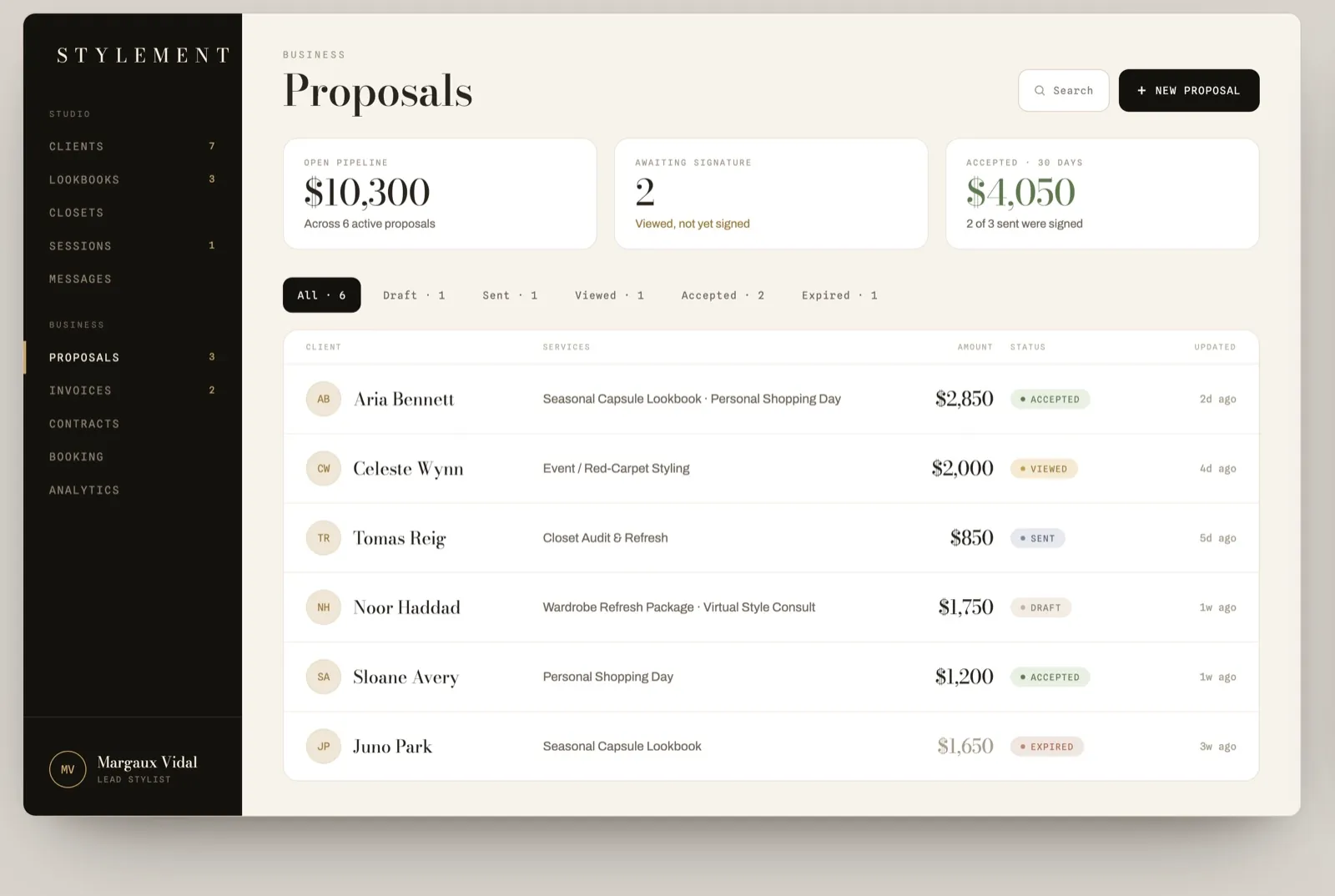
Turn an inquiry into signed work.
Intake, briefs, proposals, contracts, and e-signing in one thread. She reviews it, signs it, and pays in a tap, without leaving your studio.
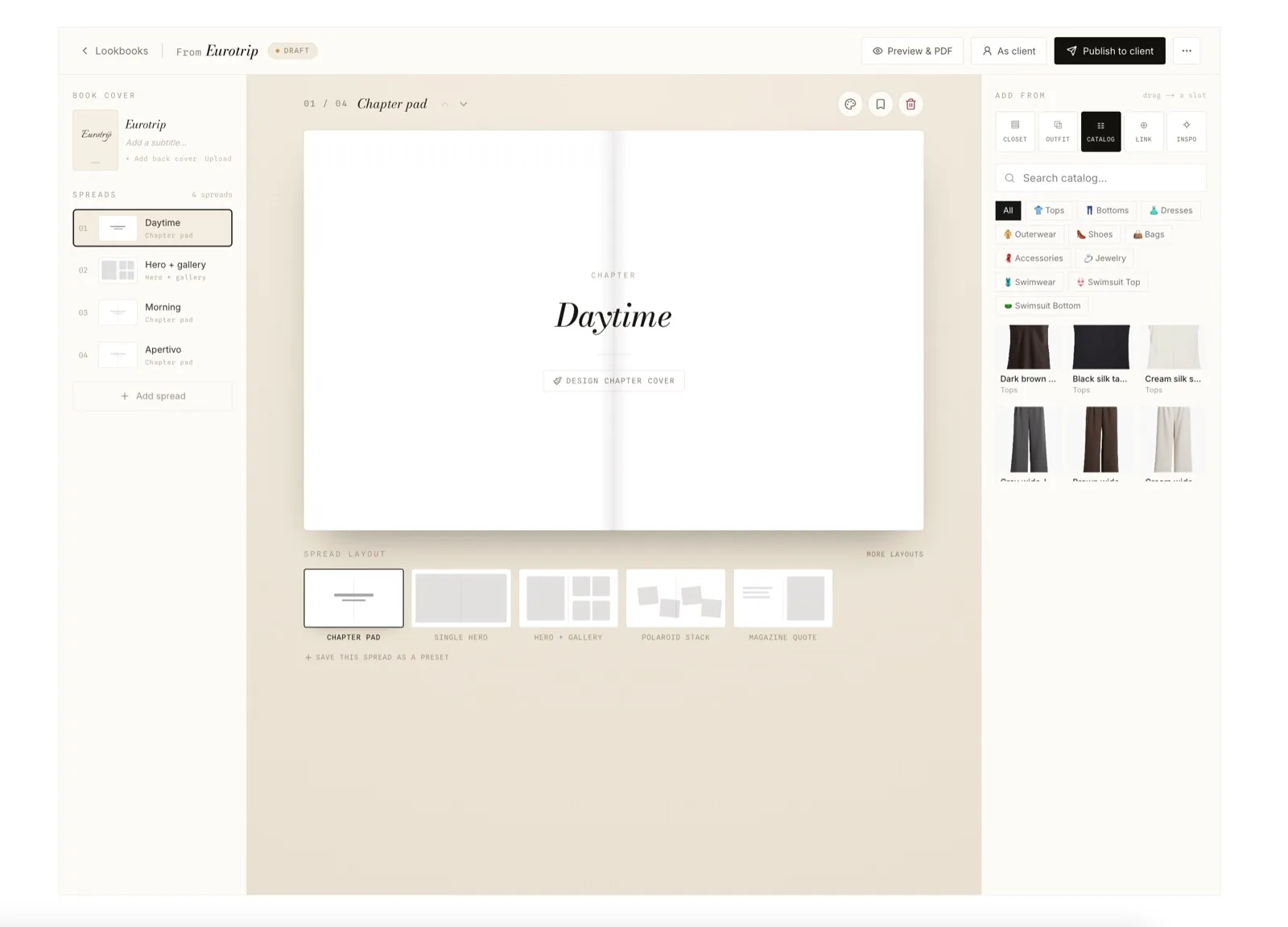
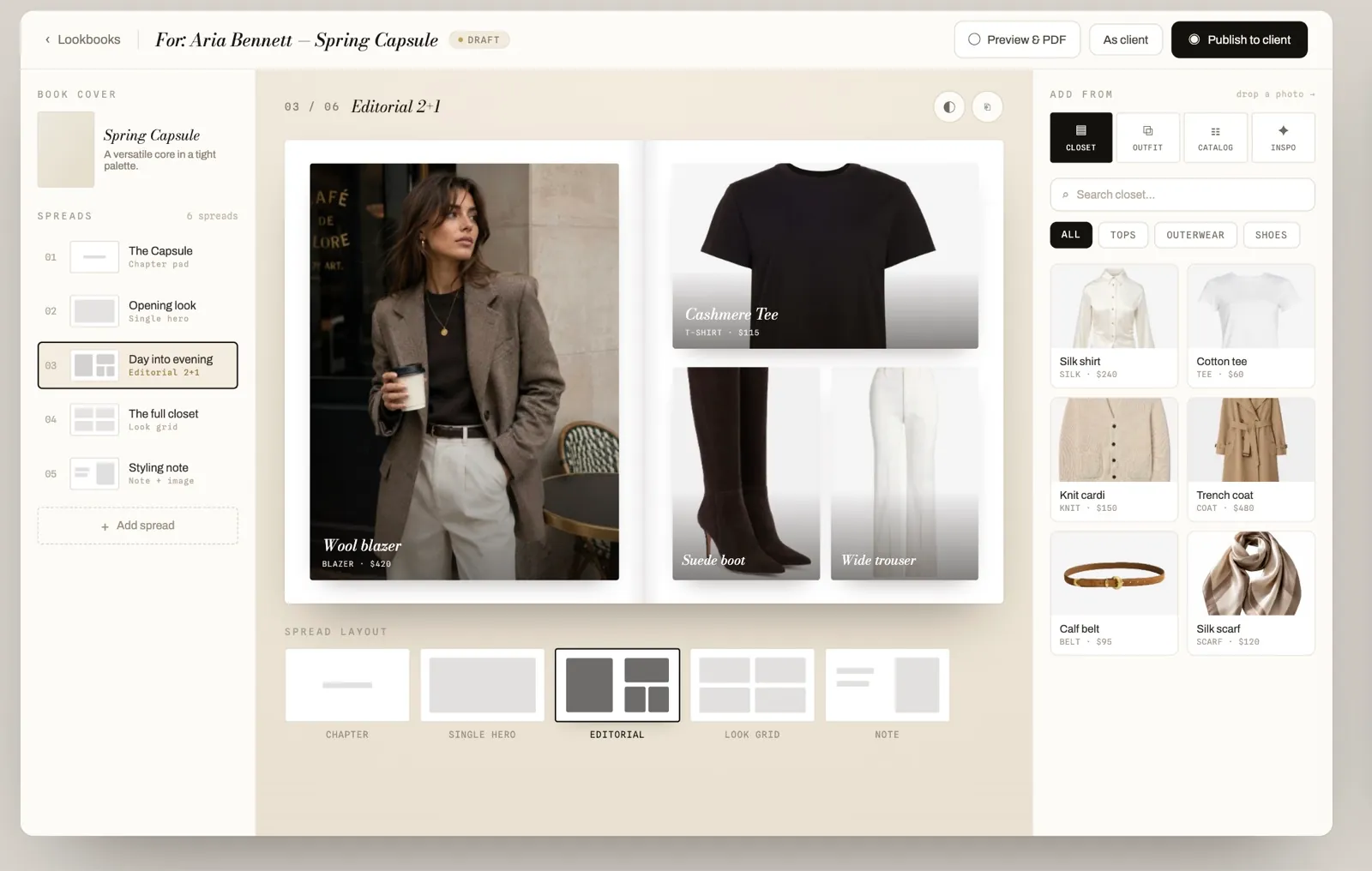
Lookbooks she can actually shop.
Editorial spreads built on a real canvas. She opens them on her phone and buys straight from the page, with your brand on every one.
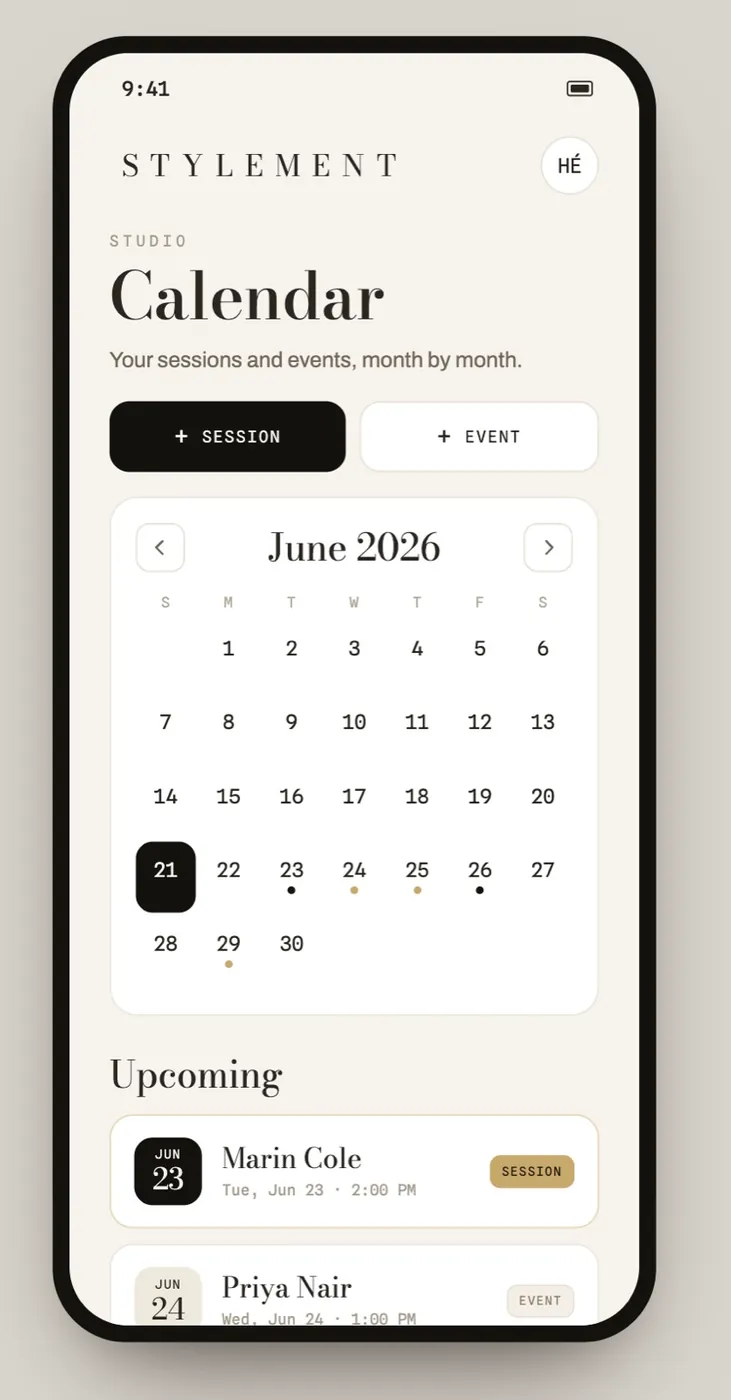
Your calendar, and the deposit, handled.
Clients pick a time in your studio and pay the deposit up front. Reminders, cancellation terms, invoices, and retainers all run behind it.
It remembers what she actually wears.
The other software in this category is built around what your client buys next. Stylement is built around the closet she already owns, and it keeps a record of what she wears out of it. So you stop re-solving the same wardrobe every season, and you can show her what a piece has really cost her per wear.
Some of these are good tools.
None of them were built for this. Dubsado and HoneyBook genuinely do run a service business, and if that’s all you need, keep them.
| Generic CRMDubsado, HoneyBook | Wardrobe appIndyx, Whering | MarketplaceWishi, StyleSeat | Purpose-builtGoodPix, Nove | Stylement | |
|---|---|---|---|---|---|
| Client closet | Not offered | Personal only | Partial | Yes | Yes |
| Client roster and pipeline | Yes | Not offered | Theirs, not yours | Yes | Yes |
| Bookings and invoicing | Yes | Not offered | They handle it | Yes | Yes |
| Seasonal color analysis | Not offered | Not offered | Not offered | Not described | Yes, 12-season |
| Travel styling | Not offered | Not offered | Not offered | Not described | Yes |
| Cross-brand size memory | Not offered | Partial | Not offered | Not described | Yes |
| Under your brand | Partial | Not offered | No, theirs | Yes | Yes |
| You own the client | Yes | Not applicable | No | Yes | Yes |
| Cut of your revenue | None | None | Yes, a percentage | None | None |
| Pricing published | Yes | Yes | Yes | No, by request | Yes, from $49 |
| See it without an invitation | Yes | Yes | Yes | No, invite only | Yes, 14 days free |
Compared against what each company publishes, September 2026. Tell us if we’ve got something wrong and we’ll fix it.
“Canva is free, and I already have my tools.”
It was never the cost. It’s the five tabs, and the fact that none of them are yours. Right now your client sees Canva, then Calendly, then a PDF. Here she sees your name on all of it.
“Not another subscription.”
It replaces several. Proposals, contracts, invoices, booking, lookbooks, and the client record arrive as one bill, starting at $49 a month.
Here are the numbers.
No demo call, no invite, no request for access. Two months free if you pay annually.
Closets, lookbooks, proposals, contracts, invoices, and booking.
Adds analytics, client segments, your logo and colors, travel planning.
For a practice running at full capacity, with everything uncapped.
One of us built it.
Stylement was built by a working stylist who got tired of running her own studio out of a camera roll. Every screen here started as something she needed on a Tuesday, with a client waiting and five tabs open.
The basics.
Do I need to be technical?
If you can use Canva and Instagram, you’re past the hard part. Setup takes minutes, and you can bring one client in to see how it feels before you move the rest.
What happens after the free days?
You pick a plan, or your studio pauses until you do. You get fourteen free days in total and the first seven need no card at all.
Will my clients see my brand or yours?
Yours. Your name, your logo, and your colors on every page a client opens. That’s the whole point of it.
I only have a handful of clients. Is it worth it?
That’s exactly when looking like a real studio wins you the next ten. Starter covers up to 10 clients at $49 a month.
How is this different from a wardrobe app?
Those help one person organize her own closet. This runs your client business, under your brand, and it remembers what each client actually wears.
Can I see it before I sign up?
Yes. The demo walks the client side of a real studio, no account needed. See the client experience.